Network segmentation: the control that decides your blast radius
Key takeaways
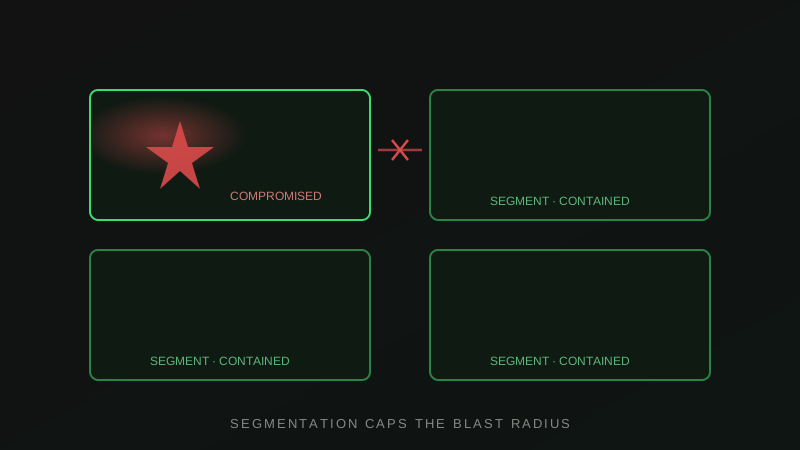
- Flat networks turn a single foothold into total compromise; segmentation caps how far an attacker can spread from any one host.
- The highest-value boundaries are around backups, domain controllers, and OT — the systems whose loss defines the worst case.
- Segmentation also forces attackers into noisier, more detectable behavior, so it improves detection as a side effect.
Segmentation is a damage-control decision
Prevention gets the attention, but segmentation is what decides how bad it gets when prevention fails. On a flat network — where any host can reach any other over administrative protocols — one phished laptop gives an attacker a clear path to every server, share, and backup. On a segmented network, that same foothold is boxed into a zone, and every attempt to reach something valuable has to cross a boundary you can control and watch.
Segment around the worst case, not the org chart
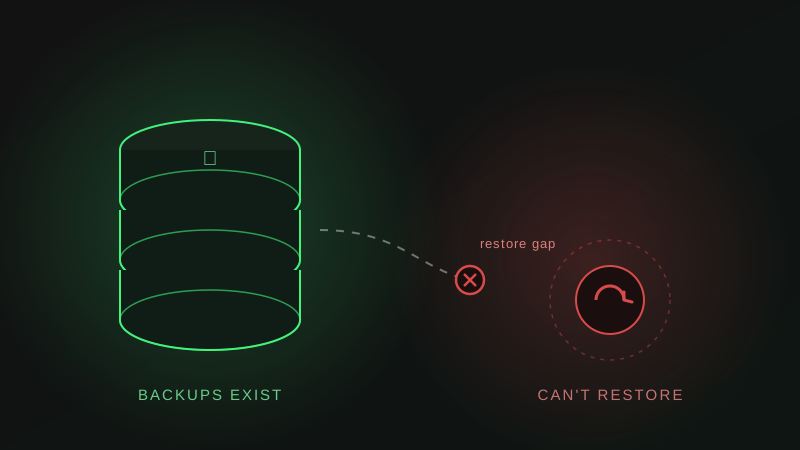
The instinct is to segment by department, but the boundaries that matter are around the systems whose loss defines your worst day: backup infrastructure (so the attacker can't reach it from a compromised workstation), domain controllers and the identity tier, and any operational-technology or production environment. If those live on the same reachable network as ordinary user devices, no amount of endpoint hardening changes the fact that one bad click can reach them.
It's a detection multiplier, not just a wall
Segmentation's underrated benefit is that it makes attackers noisy. When lateral movement has to cross monitored boundaries, the behavior that would blend into a flat network — a workstation reaching a server it's never touched, admin protocols crossing zones — becomes an alert-worthy anomaly. You get the containment and the visibility from the same control, which is why it consistently ranks among the highest-ROI investments in post-incident reviews.
Start with the reachability audit
Before buying anything, answer one question: from a typical user laptop, what can it actually reach? Most teams are surprised by the answer. Mapping that reachability — and then cutting the paths from user zones to backups, domain controllers, and production — delivers most of the benefit before you get anywhere near micro-segmentation or zero-trust tooling. The goal isn't perfect isolation; it's making sure a single compromise can't touch everything.