Reporting ransomware risk to the board: metrics that survive scrutiny
Key takeaways
- Boards care about three things: could we recover, what's the financial exposure, and is our spend reducing risk — not IOC counts.
- Translate readiness into business terms: recovery time, potential loss, and coverage of the controls that matter most.
- Show trend and benchmark, not a single snapshot — direction and peer comparison are what let a board actually decide.
The board's three real questions
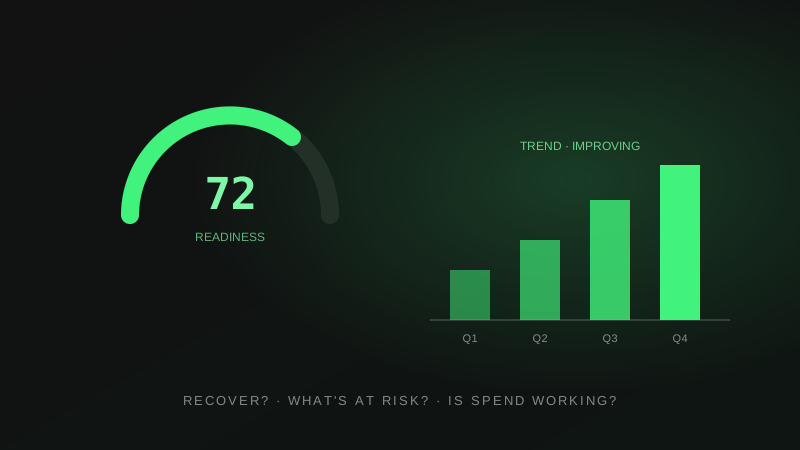
Security teams often bring boards the wrong report: threat landscapes, indicator counts, tickets closed. Directors want answers to three questions. If we were hit tomorrow, would we recover, and how long would it take? How much money is at risk — what would an incident plausibly cost us? And is the money we're spending actually reducing that risk? Everything you present should ladder up to one of those. Metrics that don't are noise to the people you're trying to inform.
Translate readiness into business terms
The most credible board metrics are expressed in outcomes, not activity. Tested recovery time for critical systems — with the emphasis on tested — answers 'would we recover.' A quantified loss estimate (business interruption per day multiplied by realistic downtime, plus response and breach costs) answers 'what's at risk.' Coverage of the handful of controls that actually change outcomes — phishing-resistant MFA on privileged accounts, immutable backups, segmentation of the crown jewels — answers 'are we investing in the right places.' These are defensible because each traces to evidence.
Direction and benchmark beat a snapshot
A single number in isolation tells a board nothing — is 72 good? They can't act on it. What lets them decide is trend (are we improving quarter over quarter, and where are we going backwards) and benchmark (how do we compare to peers in our sector). 'Our tested recovery time fell from five days to two over the past year, and we're now at the median for our industry' is a sentence a board can weigh a budget request against. A static readiness score is not.
Be honest about the gaps
The temptation is to present only progress, but boards that later discover a hidden gap lose trust in every future report. The strongest posture is to name the residual risk plainly — the systems you can't yet recover fast enough, the exposure you haven't closed — and tie each to the investment that would close it. That reframes the conversation from 'are we secure' (a question with no honest yes) to 'is our residual risk acceptable, and if not, what would it cost to change,' which is exactly the decision a board is there to make.